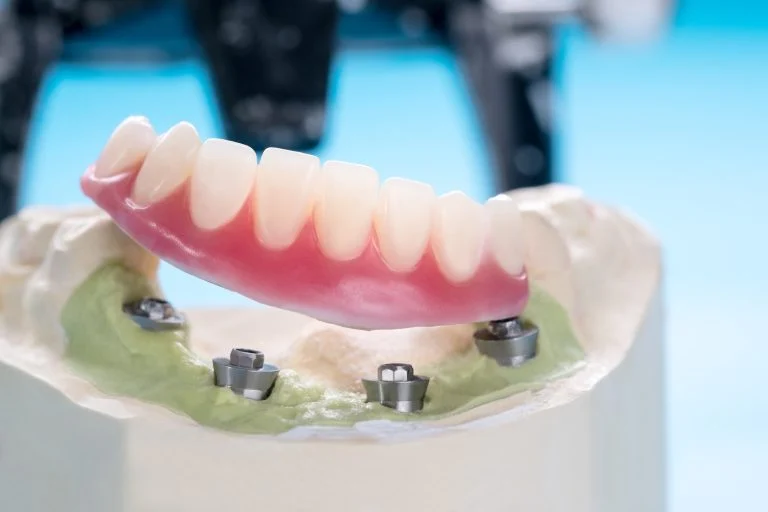

The main single missing molar replacement options are a dental implant, a fixed bridge, and a removable partial denture.
All three can restore the gap, but they differ in treatment time, daily care, cost, and how they affect the surrounding teeth and jawbone.
When the neighboring teeth are healthy and enough jawbone is available, a single-tooth implant may provide a durable solution without requiring those teeth to be reshaped.
However, a bridge or partial denture may be more suitable depending on your oral health, treatment preferences, and budget.
Because molars handle substantial chewing pressure, their replacement must be planned for strength, stability, and proper bite balance.
A dental evaluation can determine which option is most likely to function well in your mouth over time.
Key Takeaways
- An implant protects neighboring teeth and the jawbone, but it takes months and costs more at the start.
- The health of nearby teeth, your bone, and the molar’s spot in the row can change which option fits best.
- Compare lifetime costs, including future replacements, before you compare first price quotes.
Which Fix Fits Your Missing Molar?
The right fix is the one that matches your bone, your neighboring teeth, and how you want to live with the result day to day.
All three tooth replacement options can restore chewing and help keep your bite alignment steady, but they get there in very different ways.
How Do the Three Options Compare at a Glance?
Here is how a dental implant, a dental bridge, and a partial denture line up on the points patients ask about most.
| Factor | Dental Implant | Fixed Bridge | Removable Partial |
| Surgery needed | Yes | No | No |
| Nearby teeth altered | Usually no | Usually yes | Sometimes minor preparation |
| Treatment time | Usually several months | Usually several weeks | Usually several weeks |
| Upfront cost | Often highest | Varies | Often lowest |
| Helps maintain bone | Yes, around the implant | No root replacement | No root replacement |
| Removable by patient | No | No | Yes |
Treatment costs depend on the restoration selected, case complexity, and whether additional procedures such as bone grafting or a sinus lift are needed.
Patient comfort tracks closely with these differences. In a study of 200 adults with one missing tooth, patients with single implants reported the highest satisfaction, followed by fixed bridges.
Removable partials and untreated gaps scored lowest for chewing, looks, and speech. The same study found that harm to neighboring teeth was the top factor patients weighed when choosing.
When Is Each Option Most Likely to Make Sense?
Think of each option as a good match for a certain kind of mouth.
- Implant: Your nearby teeth are healthy, you have enough bone (or are open to grafting), and you want a tooth that works on its own.
- Bridge: The teeth on both sides already have large fillings or crowns, you want a fixed tooth soon, or implant surgery carries extra risk for you.
- Partial: You want to avoid surgery and tooth reshaping, you need the lowest upfront cost, or you want a stopgap while you heal or save.
A temporary partial may be used while another treatment is planned, although it does not preserve the jawbone like an implant.
If you are considering a fixed replacement, learn how dental implants replace a missing tooth without relying on neighboring teeth.
How Does Each Replacement Work?
An implant replaces the whole tooth from the root up, a bridge hangs a false tooth between two crowned neighbors, and a partial clips a replacement tooth to your natural teeth.
Knowing how each one is built explains most of its pros and cons.
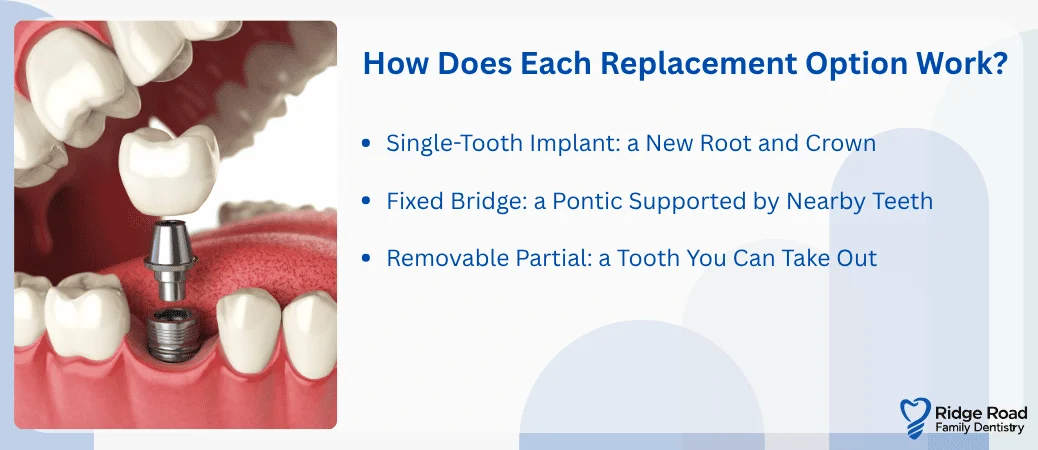
Single-Tooth Implant: a New Root and Crown
A single tooth implant has three parts. A small titanium implant post goes into your jawbone. An abutment rises through the gum. A custom implant crown attaches on top.
The key step is healing. Over about 3 to 6 months, your bone bonds to the titanium in a process called osseointegration. Once that bond is solid, the post becomes a stable base for chewing.
From a patient’s point of view, the surgery itself is often easier than people expect. Most of the waiting happens quietly while the bone heals. The post-op care guide explains what to expect during the first days of healing.
Fixed Bridge: a Pontic Supported by Nearby Teeth
A standard dental bridge for one molar has three connected units. The false tooth in the middle is called a pontic. It is joined to two crowns that fit over the abutment teeth on each side of the gap.
To make room for those crowns, your dentist shapes both neighboring teeth by removing some enamel. That enamel does not grow back. The bridge is then cemented in place, so you never take it out.
A bridge is fast. Many are done in two or three visits over a few weeks. Its lifespan is tied to the health of the two teeth holding it up.
Removable Partial: a Tooth You Can Take Out
A removable partial denture holds a replacement tooth on a small frame. Metal or tooth-colored clasps grip your natural teeth to keep it steady.
It does not require implant surgery and usually needs less alteration of nearby teeth than a fixed bridge. However, some designs require minor preparation to create stable support.
The trade-off is daily routine and feel. A partial may move slightly when you chew, take up some room in your mouth, and may need adjustments as your gums change.
What Makes One Option Better for Your Mouth?
Three details in your own mouth do the most to steer the choice: the condition of the adjacent teeth, the amount of jawbone at the site, and whether the missing molar sits at the very back.
Each one can move the best answer from one option to another.
Are the Adjacent Teeth Healthy or Already in Need of Crowns?
The impact on adjacent teeth is often the deciding point. A conventional bridge requires the neighboring teeth to be reshaped for crowns, which may be unnecessary when those teeth are otherwise healthy.
An implant may be considered in this situation because it replaces the missing tooth without requiring those healthy neighboring teeth to be reshaped.
The picture flips when those neighbors already have large fillings, cracks, or old crowns. Crowning them as part of a bridge fixes their problems and fills the gap in one plan.
Here, a bridge puts teeth that needed work anyway to good use.
Is There Enough Jawbone for an Implant?
Jawbone health decides whether an implant is simple, needs extra prep, or is a poor fit. After a tooth comes out, the bone in that spot starts to shrink.
This bone resorption happens because the area no longer gets pressure from a tooth root.
Among these three options, an implant is the only one that transfers chewing forces into the jawbone through an artificial root, which can help maintain bone around the implant.
If your jawbone density is low, bone grafting can rebuild the site first. Upper molars sit close to the sinus, so some patients need a sinus lift, which raises the sinus floor and adds bone underneath.
A 3D scan shows your dentist exactly how much bone is there before you commit.
Is the Missing Molar at the End of the Row?
This is the problem many people miss. A conventional bridge needs a supporting tooth on each side of the gap. If the missing molar was your last tooth in the row, there is no back anchor.
Your choices then narrow to two main paths:
- An implant, which needs no neighboring support at all.
- A partial denture, which clips to the teeth in front of the gap.
A one-sided bridge, called a cantilever, exists, but back teeth face heavy chewing forces that put a lot of strain on a single anchor.
At Ridge Road Family Dentistry, prosthodontist Dr. Mouawia Ghiba evaluates the jawbone, neighboring teeth, and bite before comparing an implant, bridge, or partial denture for a missing molar.
What Should You Expect for Time, Cost, and Upkeep?
Bridges and partials finish faster and cost less at the start, while dental implants take longer and cost more upfront but avoid reworking nearby teeth.
Daily care differs for each, and that routine shapes how long your replacement lasts.

How Long Does Treatment Take?
A bridge can be finished in about 2 to 3 weeks. A partial is usually ready in a similar window.
An implant takes about 4 to 9 months from start to final crown. Bone healing sets that pace. If you need a graft first, add several more months.
A temporary partial may be considered during implant healing when it can be designed without placing harmful pressure on the surgical site.
Teeth that need a graft or sit near the sinus benefit from a prosthodontist or experienced implant dentist planning the steps.
How Do Upfront and Long-Term Costs Compare?
A dental implant generally requires a higher initial investment because it includes surgery, an implant post, an abutment, and a crown.
Bridge costs depend on the materials and supporting teeth, while a removable partial denture often has the lowest initial cost.
Lifetime cost is a separate question. Any crown, bridge, or partial may need repair or replacement someday, and a bridge redo involves both anchor teeth. An implant post is built to stay put, though its crown can wear and need replacing.
No dentist can promise you an exact lifespan or future price, so ask for an estimate that includes likely replacements.
Insurance benefits for implants, bridges, and partial dentures vary by PPO plan. The team can check your benefits, submit insurance forms, and explain your estimated out-of-pocket costs.
You can review the available insurance and financing options and check whether any current special offers apply to your treatment.
How Do You Care for Each Replacement?
Each option asks for a slightly different habit:
- Implant: Inflammation around an implant can threaten its long-term health. Brush carefully and use the cleaning tools recommended by your dental team, which may include implant floss, interdental brushes, or a water flosser.
- Bridge: Food collects under the pontic. Use a floss threader or water flosser every day, and watch for decay at the crown edges.
- Partial: Take it out daily, brush it, and store it as your dentist directs. Brush the clasped teeth well too.
Regular checkups catch small problems on all three before they grow.
Choosing a Fix That Fits Your Molar and Your Priorities

The most suitable replacement depends on your jawbone, neighboring teeth, bite, health, and treatment preferences.
An implant may suit a gap bordered by healthy teeth, while a bridge may make sense when the supporting teeth already require crowns. A removable partial provides a nonsurgical alternative.
If the missing molar was the last tooth in the row, a conventional bridge is usually unsuitable because there is no supporting tooth behind the gap. An implant or partial denture may be considered instead.
Before you decide, ask your dentist for three things:
- A scan showing how much bone you have at the site.
- A frank look at whether your neighboring teeth need crowns anyway.
- A cost estimate that covers both the first visit and likely future work.
With those answers, you can make an informed decision based on your oral health and priorities.
Frequently Asked Questions
Can I get a bridge if my missing molar is the last tooth in the row?
A standard bridge is not a good fit, because it needs a supporting tooth on both sides. An implant or a partial denture is the usual answer for a last molar.
Some dentists consider a one-sided cantilever bridge, but heavy molar chewing puts a lot of strain on it.
Will I need a bone graft before getting a molar implant?
A bone graft may be recommended when the available bone is too thin or short to support an implant securely. A 3D scan helps determine whether grafting or a sinus lift is needed.
Does a bridge or partial denture prevent jawbone loss?
No, neither one stimulates the bone under the gap the way a root does. The space is filled, but the bone there keeps slowly shrinking. An implant is the option that helps preserve bone at the site.
Can I wear a partial denture while waiting for an implant?
A temporary partial may be worn during implant healing when it can be adjusted to avoid pressure on the surgical site. Your dentist will determine whether it is appropriate for your case.
How soon after a molar extraction should I discuss replacement?
Discuss replacement before or around the time of extraction when possible. Early planning allows the dentist to evaluate bone preservation, healing time, and the condition of neighboring teeth before they change.